Wednesday, June 29, 2011

Yesterday

Yesterday was a pretty cool day. I had a pretty good Push Press workout, felt really good. Went and did a Yoga class afterwards with a client and a co-worker, good shit. Then I met my internet idol and shot the shit with him for 10 minutes. No big deal.


In all seriousness, meeting Mr. Gentilcore was pretty cool. This guys is as close to a celebrity as you get in this industry without being a sell-out no-talent wanna-be-a-trainer hack that no one respects.

What? A sellout? Me?
This man co-owns a nationally respected strength and conditioning facility, writes one of the most popular strength and conditioning blogs around and gets published in cool magazines. Pretty badass, I'd say. 

Meeting him was good because it definitely helped me realize how much more work I had to do, both intellectually and physically if I want to get where I wanna go in this industry. Meeting someone of his caliber was a big eye opener, a really good wake up call. No matter how smart you think you are, there is always somebody smarter.

Now, its time to work out. Find something heavy. Pick it up.

Monday, June 27, 2011

Squats or Deadlifts?

Does it matter?


Regardless of which one you choose, it is better than doing chest and arms 5 times a week.

So, you know you should be doing them both, but in what ratio? Let me make some suggestions.

I teach both lifts to all my clients, in some form or another. However, I deadlift them much more often and with much  more intensity than I squat them. Why? Correcting imbalances. We are a nation of quad dominant people. When someone "does legs", it usually means they spent some time on the leg press trying to give themselves a hernia. Afterwards they went to the leg extension and, if they actually did a free weight exercise, did some lunges. They may have spent some time on the hamstring curl machine, but who knows. Assuming they did ham curls, their leg workout was a 3:1 quad:hamstring ratio...which isn't very good. Add to that running on the treadmill (quad dominant) walking up and down stairs (if someone actually does it) and spending time in shoes with big heel lifts and you have a recipe for quad dominance.

By deadlifting my clients more often, I look to equal out this imbalance. We certainly don't ignore the quads, however. I program in lots of lunge variations, goblet squats, overhead squats and single leg squat variations. These are all exercises that use a sub-maximal load when compared to back squats.

Another positive about deadlifting more often is that it goes a long way to help correct kyphosis caused by spending lots of time at a desk or computer. Although, as recently pointed out, it is not the end all and be all of postural corrections (Eric Cressey is smart). It does go a long way in putting loads of muscle on someones posterior chain, which is a place ignored by most Average Joes. The deadlift also strengthens one of the weakest point on most peoples bodies: the lower back. People tend to stay away from low back exercises because they "don't want to hurt themselves". Well, NOT doing low back exercises is just  as damaging in the long run. You are much better off doing safe and worthwhile exercises.

What an attractive, smart and humble guy.
The last big reason I deadlift my clients more than squat them, is that it is just a touch safer. I recently heard someone say "train the deadlift, perfect the squat". Suggesting that you can work around slight mistakes in form with a deadlift; worse comes to worst and you will really only injure soft tissue. A mistake in form with the squat can result in ligamentous or cartilaginous aspects of your body.

DISCLAIMER: This is not a free pass to go deadlift with shitty form, you still need to work with perfect form as much as possible. But in a max effort, a little bit of leeway is allowed in the deadlift.

People like to say that squats are bad for your knees. Those people are stupid and should be mocked. Correctly executed squats should not be detrimental to your knees. However, some of us have a pre-existing condition in our knees called "beat the shit out of them for a long time playing sports". For those of with said condition, squatting often leaves us feeling pretty beat up. For those people, deadlifting is the answer. It will allow you to keep lifting heavy with minimal stress on your knees, or you can even choose variations that will allow for a little more quad recruitment (snatch grip deadlift, trap bar deadlift). 

So, in my opinion, the average joe would probably get a little more benefit out of deadlifting than squatting. This is not to be taken as an infallible truth, simply as an opinion. 

Whether you want to squat or pull, go do it...and make it heavy!!


Wednesday, June 22, 2011

SkinnyFat Girls

This is an issue that has been plaguing us for decades. Skinnyfat girls. They are everywhere. It starts at the top, in the fashion magazine. As the saying goes, shit rolls down hill.


This is usually a result of someone being "skinny" based on how they look in clothes. They will eat 1000 calories a day, smoke 2 packs of cigarettes and walk on a treadmill for 3 hours in an effort to be "skinny".  They achieve the desired size, but do it without a second thought about muscle mass.

This is where we get the skinnyfat look. You are all skin and bones. Skin just falling right off of you. Shit is gross. Girls like it because they can fit into skinny jeans, and dresses look good on you. Clearly skinny fat doesn't mesh with bikinis, though.


I mean, seriously? Who thinks that looks good?

The good news is that Nia Shanks recently released a product that will help us eradicate skinnyfat girls forever! Lean Muscle Mass for everyone! Beautiful Badass is a program specifically aimed towards women that will help gain lean muscle mass, decrease body fat, and look amazing. If you don't believe it, go take a look at Nia. She is walking proof.

Go find something heavy, and get it off the floor!

Tuesday, June 14, 2011

Tuesday, May 17, 2011

When you just don't have it.

If you've been exercising for any amount of time you know that some days you just don't have it.


Gassed. Pooped. Running on empty. Exhausted. 

Regardless of how you say it, it means you are having a tough day. It happens to everybody, myself included. Sometimes you can crush a Spike Energy drink, a Red Bull or even a cup of coffee, and feel good enough to get through you workout. 

Then, there are those other days. You just don't have anything in you. What do you do? Do you go ahead and try and grind out the workout? Do you pack it up and head home? 

If you decide to stick around, what happens? You try and grind it out; your warm up sets feel heavy, your feeler set feels like a max effort, and you get stapled by what was an easy training weight the week before. You get frustrated and wanna work through it, you try and push harder on the next set and tweak a muscle. Now you have had a shitty workout and hurt yourself. Fantastic!


Or, you could just call it quits and head home. Then, you would feel like a slug because you didn't get in a workout. You'd call yourself lazy and weak. You'd beat yourself up about it and feel like shit. 

The other option, is to just do SOMETHING at the gym. Maybe you go through your first big lift (squats, deads, bench, push press, etc) at a much lower percentage than you are used to. Get your blood flowing and your muscles working, then see how you feel. If you feel like dog shit still, then beat it. Go home. Discretion is the better part of valor. If you feel ok, then try out your next exercise. Play it by ear. 

Auto-regulation is a great thing when used appropriately. I'm all for toughing it out and working through things, but sometimes its really just not worth it to push through that shitty feeling. 

Find something heavy. Pick it up. 

Wednesday, May 11, 2011

The Crossfit Post

It had to happen sooner or later. There was really no avoiding it. The irresistible force meets the immovable object. I had to talk about Crossfit at some point. The following is purely my own opinion, based on my very limited personal experience with the Crossfit system.


A history...
Crossfit is a training system developed in the mid-90's in California by Greg Glassman. It is a system focusing on General Physical Preparedness (GPP) that has been popularized within the military, police forces and fire departments. Classically, the Crossfit system utilizes a sort of turbulence training effect by having each Workout Of the Day (WOD) be something completely different. Today might be 5 sets of 3 conventional deadlifts, and tomorrow might be 13 muscle ups, 50 burpees and quarter-mile run. They also have "Benchmark Workouts", named for various Crossfit superstars as well as military Crossfitters who lost their lives in service. These serve as a way to measure your progress in the system.

The system revolves around 10 basic fitness tenents: endurance, stamina, strength, flexibility, power, speed, agility, balance, coordination and accuracy. All of their workouts revolve around these basics, and many workouts involve multiple facets. WODs will include cleans, snatches, deadlifts, squats, gymnastics moves, running or medicine-ball work. The idea is to prepare you for anything you might encounter.

Crossfit originally gained popularity through its home page, where anyone could go and see what the WOD was, and follow it on their own. In the last 2-3 years, Crossfit Affiliates have begun springing up all over the country, in massive numbers. The Affiiliates are simply privately owned Crossfit gyms; basically a franchise. People are now more inclined to go to these gyms and pay the membership costs in order to workout with like-minded folks. As of late, many of the Affiliates have begun to do a really good job with supplementing the WOD with progressive-overload style strength and conditioning. Crossfit also holds an annual "Games" where affiliates/individuals from all over the world get together to compete and see who is the best.

The Pro's. 
The most important thing I have noticed about Crossfit is the camaraderie it builds amongst its participants; I LOVE that about Crossfit. The people you work out with become your friends, your teammates and your foes. Working out with these like-minded people pushes you to work harder, thus getting better results. You cannot underestimate the drive that you get from working out in a gym with a great work ethic. The system has Benchmark workouts built into it as a measuring stick, you can always go back and check your progress against yourself. Crossfit also exposes people to many different aspects of fitness; olympic lifts, power lifts, endurance and gymnastics themed stuff.

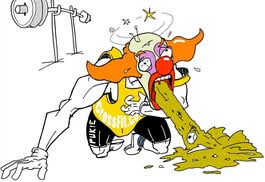
Crossfit provides a fantastic place for a former athlete to work out that has a similar atmosphere to the weight room in college. Loud, noisy, sweaty: everyone is there to work. If someone goes in the corner and pukes, so be it. Shit happens.


Cons.
My orginal "Con" regarding Crossfit goes back to how they gained popularity: the homepage. The workouts provided on the homepage can be followed by anybody; any ass-clown at their local Golds Gym can check it out, and then try and complete the workout. The argument against this, is that anyone can look up any workout and go try it and hurt themselves. This is 100% true, but Crossfit workouts become especially dangerous when you use the combination of high reps and technical lifts that are common in their workouts. For example, here is todays WOD.


As an advanced workout? Not bad. For Joe Schmo at Golds? Not a great idea. Overhead squats are a pretty technical lift, and then couple that with an energy sapping explosive lift (squat snatches), an extremely metabolic exercise (double unders) and one of the tougher core exercises out there (toes to bar) for 5 rounds as fast as possible, and that sounds like a recipe for disaster. A Crossfitter will always say "well, the workouts can be adjusted based on level". True, if you go to an affiliate. If Tommy Toughnuts at the gym wants to try a CF workout, and sees that on the homepage, that is what he will try....and he will most likely get crushed, if not hurt.

The technical aspects of many of the lifts, combined with the high rep nature is what many strength and conditioning coaches will point to when asked about CF. Most coaches agree that the technical aspect of the Olympic Lifts require them to be performed at a high intensity with short rep ranges (usually 1-5) that will prevent a breakdown of form. CF, however, feels differently. A recent workout was 3 rounds, round 1: 21 reps, round 2: 15 reps, and round 3: 9 reps. The circuit was 24" box jump, 75# power snatch and chest to bar pullups. So, by the end of the workout you will have completed 45 reps of each exercise, in as short an amount of time as possible. 45 power snatches, as fast as possible? Not a recipe for perfect form, if you ask me.

The other aspect of CF that bugs me is the apparent lack of programming. It appears that the WODs are put up in a fairly random style. I understand that this is where the GPP style of training comes in, but how are you expected to improve if you have no room for the progressive overload system? If you never know when you will be deadlifting again, you cannot improve at it. In fairness, a lot of the affiliates have done a great job with adding in a "strength" component to their workouts. Athletes will often complete the strength portion of the workout prior to doing the WOD. This gives them some time to work on technique and use the progressive overload system to add weight to the bar. The strength portion will often be lifts used to "assist" the athletes in the WOD. For instance; the strength exercise will be a front squat; that way the catch/downward movement phase/drive (essentially a front squat) will never be the weak link.

Maybe I was wrong about Crossfit...

Wrap-Up
Maybe there are some holes in my theory; like I said, I've never really done Crossfit (I would like to spend some time at a Crossfit gym, though). That is the secret to CF, I believe, being at the gym with other Crossfitters. No, I don't think Crossfit is a system for everyone. I think that everyone should spend some time using progressive overload, as well as the conjugate system for a while to build their baseline level of strength. If you are obese, you need to spend some time working on your metabolic conditioning as a baseline. Throwing someone who has no baseline level of fitness into a CF class doesn't make sense; they still need to work on the basics.

However, I actually do think Crossfit has a lot of benefits; especially now that the Affiliates are so accessible to everyone. This makes it a much more legitimate, in my opinion, player in the fitness industry. Left unguided, someone could really hurt themselves attempting to keep up with WOD on the homepage. Under the supervision and scrutiny of coaches, it is a million times safer. Also, it is nice to see that Crossfit coaches are now coming from the strength and conditioning world; if you peruse the site, a lot of them are now coming with legit NSCA and ACSM and NASM certifications, to back up their Crossfit certs.

Above everything else, you just can't overlook the benefits that the atmosphere and culture has on its participants. I really think an athlete will get more out of a shitty program in a great enviroment then a great program in shitty enviroment. Its just tough to give it your all with 45 year old guys benching 65 lbs and 25 year old women doing 3 lb bicep curls behind you.

In the end, as long as you're lifting heavy shit, you're on the right path. If you do crossfit, or 5/3/1 or Show and Go, you're still doing something!

Tuesday, May 10, 2011

Planet Profit

So, there has been a lot of talk in the fitness industry about Planet Fitness and their whole advertising campaign as of late. They have a line of commercials portraying some stereotypical bodybuilders in a less-than friendly light.


Frankly, I think it's pretty damn insulting. If Cressey Performance or Mike Boyle Strength and Conditioning was to put out a commercial showing them leading an obese person out the door, suggesting that this wasn't the place for them, the shit would hit the proverbial fan.


Fat people would be lined up around the block complaining that this was discrimination, and they should be allowed to work out wherever they want, they are just like everybody else, etc etc. Which is all totally, true, mind you. I think any "fitness" club should allow anyone to work out wherever they please; I don't even agree with women's only facilities. I've worked out in a lot of gyms in my life, and I rarely have seen a situation where a guy was really leering at a girl.

I can't help but feel like Planet Fitness's real intention is not Fitness, but revenue. As this article states, Gym Rat Control, they are run by a very shrewd businessman. The whole idea is that they target people who are not, shall we saw, fitness enthusiasts. These are people that "want" to have a gym membership but know they will rarely use it; so they go buy the $10 per month membership. This allows them to feel good about having a membership, but they also won't cancel when they don't use it because it is only $10 per month. This way, Planet Fitness gets TONS of members who never use the gym and will never cancel their monthly. Boom, instant revenue.

By excluding gym rats, i.e. people who will actually use their membership, they cut out the costs that are involved with a gym that gets heavy usage: cleaning, more staff, equipment. In terms of a business model, its a great idea. As it relates to fitness; its awful.


There is a saying in sports, "to get better, play against people that are better than you." If you only play against people you know you can beat, your game never gets better. If you go down and play against some guys who dunk on you and drill 3's in your eye all day, your game will step itself up. If you only work out in a gym full of fat people, you will never really get fitter. If you are working out around people that are bigger, stronger and leaner than you then maybe you will find some new motivation. Maybe you can <gasp> ask them for help, and can learn something new! Being the fittest person in a gym full of fat people is like winning a gold medal at the special olympics.

Now, go lift something heavier than anyone else in your gym!

Monday, May 9, 2011

THAT Guy at the Gym

Every gym has one. He is that guy. Everyone knows who he is, for better or for worse. He is there 6 days a week, working out. That guy has many qualities, and no two are alike. Some gyms, god bless their souls, have more than one. We have several impostors, but only the one takes the cake.

That guy is tough to explain. The main characteristic is that he is a guy who is, actually, in pretty good shape, regardless of the sanity behind his workout routine.


Our own that guy (lets call him DB) is actually a really good guy. DB is a smart guy, who has time to read up on fitness stuff. He knows enough to wade past the Muscle Mag and Flex magazines, and finds decent blogs to read and gets his info from pretty good sources. DB has no background in Exercise Phys, which makes it tough for him to sift through the endless amount of crap available to read on the internet.

One of the things that makes DB that guy is his status as a beginner to exercise; as long as he sticks to something for 2-3 months he will get some sort of results. This makes the TRX workouts fantastic, and the navy seal circuit training a killer, and the Oompa Loompa designed KB program he is doing now is the greatest thing ever!

Another interesting trait to our DB is what he thinks counts as "ok" at the gym. Theres the time he broke his finger on a plate shadow boxing in the weight room. There is his endless chatter, which mimics a house full of chickens. Above all, though, is the smell. Our DB thinks that rocking the same pair of gym clothes all week is "ok" because he is at the gym, its ok to smell. I agree, being sweaty at the gym is a great thing; and yes, for some people that makes a little funk goes along with it. However, smelling like the inside of a horses asshole does NOT need to occur at the gym. If I can tell you are in the facility by catching a whiff of your stink-trail, that is not a good thing.


This individual had been at the gym for about 2 years before he came to me to use one of his free sessions. I had observed him do his bodyweight circuits, and TRX circuits and his Charles Staley High Density routines, and I decided to teach him the good shit: we went right for squats and deadlifts. You know what? Homeboy didn't know either one. His squat lacked proper depth due to some flexibility/mobility issues. He had never deadlifted and had trouble with lower back rounding. He kept telling me, "oh, I can feel that my left glute medius isn't firing, thats making this really tough, my hip keeps hiking, my quadratus lumborum isn't activated, wah wah wah". 

Excuses are like assholes, they all stink and everybody has one. 

Now, let me say, that some people have legitimate injuries or malfunctions that will not allow them to perform certain movements. He is not one of those people. He reads too much and thinks he knows too much to let him do a strength movement correctly without injuring himself. DB is a great example of a guy that started at 0 as beginner, jumped right over the basic stuff and landed at level 5 with all the High Density workouts and speciality circuits. 

I can't stress enough the importance of starting with the basics. Having a baseline level of strength will make everything you do after that much more effective. Plus, the basic lifts are the best for any level of lifter. Seriously.

Now, go lift something heavy. But make sure you bring new gym clothes with you.

Thursday, April 28, 2011

High School Athletes

Why is it so hard to get High School aged athletes, specifically boys, to lift weights? In my gym, I've been lucky enough to be designated the "strength guy" by my co-workers. When someone comes in looking for a trainer to help them get stronger for sports, or for daily life, I tend to be the one who's schedule they look towards. I find this extremely flattering, and sort of revel in it. As a result, I have had several High School athletes under my tutelage, incidentally they have mostly been Lax kids; which is funny to me because it is one of the few sports I have NEVER played.

Sick spoon, brah. 

Regardless of having never played the sport, preparing a High School athlete for their season is not rocket science. Make them bigger, stronger and faster and you have succeed. Throw in some injury prevention and you're golden. Sounds like what every High School kid wants, right? 

If you guessed yes, you guessed wrong. Getting these high school boys to subscribe to the theory of doing compound lifts and NOT bicep curls was extremely difficult. The 15 year old girl I trained bought into it nearly immediately, but not the boys. They have such a hard time wrapping their heads around doing something that doesn't benefit the mirror muscles. Even when an exercise DOES benefit the mirror muscles, they want to do something else. Pushups? No way, can't we bench? 

I can bench. YOU can't bench. YOU can't even do 10 pushups. Pullups, forget about it. 

So, why is it so difficult to get High School aged boys to lift weights. I read the Cressey Performance blogs all the time, and they are constantly talking about the great results they are getting with their high school aged athletes, but the ones I see don't even want to be in the weight room. They saw off-season strength and conditioning as a completely secondary tool, something that fell way behind their interest in just playing more Lax. How do you really get a 17 year old boy to understand that sport specific skill will only take you so far? That being bigger and better than everyone on the freshman team is only going to last so long; when you make varsity, someone is going to hammer you. At some point, being 6' and 150 lbs is not going to work out for you any more. 

So whats the deal? I don't get it. When I was in high school, if a bigger, stronger older guy told me what to do to get bigger, stronger and get girls to make out with me, I would've done it! Without thinking twice. Deadlifts? Making out? Done and done. 

I wonder if they would do their lifts if Leryn Franco told them to?

Go lift something heavy. Do it for Leryn!

Tuesday, April 26, 2011

Seriously, dude?

There was a tiny local gym in the neighborhood that recently went out of business. My facility absorbed quite a few of their members, and interestingly, it is pretty easy to tell who came from that gym. They were "gym rats" in the sense that they spent a lot of time there, and formed a nice little community. The side effect to this, is that they all have a lot of the same bad habits. They perpetuated a "Crossfit type workout style" that many of them use; however, they use it poorly.

Ding Ding Ding!! Here comes the failboat!!

Now, I don't hate Crossfit. It is a great system to improve GPP and athleticism....when used correctly. When used improperly, it is just a great way to make you small and weak. And small and weak is no way to got through life, son!


This brings to me one guy that just cracks me up. He is a big guy, fairly athletic looking. First day he came into our gym, I thought "this one has promise, let's see what his routine is like". A few minutes later, he comes out of the locker room, ready for for battle. He has his cutoff t-shirt on, Vibram KSO's on his feet, lifting straps around his wrists, its on like donkey kong! He goes through a sort of dynamic warm-up (thumbs up) stretching and moving his whole body. Then he heads to the Cybex ab machine.

Wait. What?

Yup, sits on the ab machine with his Vibrams and wrist straps on, and crushes a few sets of abs. Weird. He then heads back to the free weight section and hammers out some heavy rack pulls.

Shit. No. That is what I was doing. He sat down and did some sets of 20-25 rep overhead DB presses. Seated overhead presses. With his wrist straps dangling. Uh, sweet dude. I watched nearly his entire workout. Not a single move that would necessitate wrist-straps, and nothing that would make use of his Vibrams. Everything was some variation of a seated push. Really? For serious?

Being a gear-whore is one thing (I, personally, am a sneaker whore), but not even knowing how to utilize your gear is lame. That sir, makes you a douchebag!

Monday, April 25, 2011

Just how fit do you need to be?

I've written about this before, but it always needs reiterating.

How "fit" do you NEED to be at any given moment?

Periodization is king for a reason. You do not need to be at your "peak" conditioning year round, its just ludicrous. Athletes don't do it, why do you need to?

Spend some time working on maximal strength. Doing 95 pound hang cleans if you weigh 130 really isn't that useful. Being 130 lbs and deadlifting 260 would be a much more impressive feat of strength, and much more useful to your daily life. If you're not competing in any sports, why do you need to have great explosive strength? You'd be much better off improving your baseline level of strength.

If you weigh 130 lbs, what are you doing running 3 miles on the treadmill every time you go to the gym? You don't need to lose weight. You're not challenging yourself and trying to get the time down. You're setting the treadmill to 6.7 and putting in the miles each day. What is that doing for you? If you're not training for a 3 mile race, it's not doing much. You'd be far better off going to find a basketball court and doing some suicides. Or finding a hill and crushing some hill sprints. Things that require explosive muscular force that will build hard, useful muscles.

I bring this up, because of a guy I know who comes to my gym. He weighs about 145 lbs, and I usually see him doing some sort of "Crossfit style workout". I have my thoughts about Crossfit, but now is not the time for that discussion. Basically, he does a fairly metabolic workout with short rest periods, lower weights and high reps and sets. Cool; it's a great way to boost your work capacity, endurance and burn calories. Is that really what you're looking for, Skinny-guy-that-cant-fill-out-a-small-t-shirt?


I still don't understand why guys have such a hard time asking people for advice. If you see someone at the gym who looks like what you want, coughcoughMEcoughcough, GO ASK FOR ADVICE!! Especially if he works at your gym!

Now, go lift something heavy! And if you dont know how, ASK!!

Friday, April 22, 2011

New Ways to get Beastly

Todays exercise comes courtesy of Glenn Pendlay. I really know nothing about him, except that he is an olympic lifting coach who has a pretty sweet row variation named after him.

What it is: The Pendlay Row


Why it is sick: Great upper-back exercise. Great lower-back exercise. Great carryover to the deadlift. Great exercise in general. Each rep requires resetting your position, so that one second pause allows you to go heavier than you can with a traditional barbell row. You use as little body english as possible (none, hopefully) so you really need to fire your upper back explosively in order to do it right. The Pendlay Row also has a great carryover to the deadlift, because it essentially puts you into the position to start your deadlift. Upper back strength is really important in moving serious weights in the deadlift, which makes this a really useful exercise.

Now go give it a shot!

Thursday, April 21, 2011

Intervals vs. Steady State

This is one of the longest running, most hotly debated questions in the fitness industry. There are tons of answers, and if you "want" an answer, I'm sure you will be able to find it. If you WANT to run on a treadmill like a gerbil for 45 minutes, you can find research to back it up. If you WANT to wake up at 5:30 to do 60 minutes of fasted steady state cardio, you can find the research to back it up. If you WANT to run backwards on an elliptical while slowly sipping the blood of an unborn Cobra, then you can probably find the research to back it up. 


Admittedly, it can be tough to sift through the bullshit. And Lord knows there is a lot of it floating around out there. But use some common sense; does waking up and doing an hour of cardio on an empty stomach really seem like a great idea to you? 

There are two ways to break this down, scientifically and anecdotally. We will go with science first. 

So, here is how it works. When you do steady state cardio (i.e. 45 minutes on a treadmill at one speed), your body will consume a higher number of calories derived from fat tissues. When you perform interval training (i.e. 30 seconds of sprinting, followed by 90 seconds of recovery, repeated multiple times) your body will consume a higher number of total calories. 

Lets use some numbers to quantify it. Say you do 45 minutes of exercise, one day it is steady state hamster cardio and the next day is interval training. On hamster day, you burn 350 kcals, and 75 of them are kcals derived from fat sources. Thus, 25% of your total calories were derived from fat sources. The next day you do interval training, and burn a total of 450 kcals, and 75 of them are from fat. This results in only 16% of your calories being derived from fat sources, but you also burned 100 more calories total!  

As we know, the name of the game in weight loss is the difference between the calories you can take in vs the calories that you expel (calories in - calories out). If you burn more calories than you consume, you will lose weight. ***

***DISCLAIMER: I am not taking into account changes in body composition. Weight loss is not just about burning calories during exercise, but changing your basal metabolic rate by adding lean muscle mass to your body. I know that weight loss is not comprised of just cardio, but also weight training. 

So, if I can burn more calories in the same amount of time by doing interval training, then that sounds like something I would want to take part in, yeah? 


So, why don't more people do it? Easy: because intervals suck, they are hard as shit. Average Joe Gymgoer is extremely adverse to doing things that are hard as shit. That is why the squat rack has become the curl rack in many facilities. It is way easier to climb onto the elliptical and grind away for 45 minutes while watching Rachel Ray and reading US Weekly than it is to get onto the rowing erg and crush some 30:30 intervals for 15 minutes, or go to the field and hammer at some 50 yard sprints.

Anecdotally, my favorite comparison is between sprinters and marathoners. Who would you rather look like?


For the most current example, lets see what the winner (and world record setter) of the 2011 Boston Marathon looked like:


This is what Usain Bolt, the gold medal dominator of the Beijing Olympic sprinting events:


Not even a contest, for me. 

Ladies? Desiree Davila, the winner of the 2011 Boston Marathon:


LoLo Jones, one of the top sprint athletes for the US Womens Olympic team:


I don't mean to take anything away from the Marathon athletes; they are amazing and do things that I can't even fathom. 26.2 miles in 2:02? I can't even drive that fast. As impressive as they may be, I don't wanna look like them!

Now go sprint somewhere!

Wednesday, April 6, 2011

OW my knee hurts!

No kidding! Everyones knees hurt at some point. As a personal trainer and a volleyball player, I hear this complaint more than any other. Now, I understand "scope of practice". There are several ways to go about alleviating general anterior knee pain, but if it is severe or pro-longed, you should go see a doctor. One of the ways that I use to determine what kind of knee pain someone has (chronic, acute, congenital) is to see if it ever changes their gait. If it affects the way you walk or run on a daily basis, you should definitely go see a doctor so that he can refer you to a PT.

If it looks like a duck, and went to medical school...
There are a few simple ways to take care of general anterior knee pain; the type of knee pain most people are talking about when they tell you their knee hurts. They revolve around being weak and being tight; the two things that cause most of our joint pains. 

In terms of strength, its either not enough overall strength, or its an imbalance caused by improper exercise. A lot of recreational, even competitive, athletes will only play their sport and not do the proper strength and conditioning to go along with it. This results in a dominance in certain muscle groups; in terms of volleyball players we see a huge reliance on the quadriceps for propulsion and for landing. They want to do everything on their toes to incorporate as much quadriceps as possible. This leads to weak hamstrings and glutes, which causes poor hip extension and increases pressure on the patello-femoral joint. Fix it by deadlifting! To take this a step further, you can get an imbalance within the quadriceps muscle. If your Vastus Lateralis (the big muscle on the outside of your thigh) is much stronger than your Vastus Medialis Oblique (the little tear-drop just above your knee) then you can suffer from a sub-luxating patella; that is, a kneecap that doesn't track properly. One of the best ways to fix this imbalance is to get off the leg press and leg extension and start lunging and squatting. 


Now, some people may be doing these exercises and still be experiencing knee pain. There are some other causes, as well. One of the muscles that plays a huge role in control of the hips is the Glute Medius.  One of the easiest ways to check the function of a client's glute medius is by watching them squat; if they experience valgum stress on the knees (knee caving) during a squat. There are a few simple exercises to help with this; squatting with a band around the knees, sitting with a band around the knees and pressing out, or X-band walks. 


These will also help with instability issues when performing a lunge. Weird how its all connected, no? Instability/weakness at the hip joint causes pain at the knee by the transfer of stress. Your body simple shoots the stress down the muscles, and suddenly your knees hurt.

Those are the big muscular deficiencies that can cause general knee pain. The other big thing is soft tissue quality; flexibility and mobility. If you move like crap, you're gonna feel like crap. Hip mobility and ankle mobility are going to play a HUGE role in the way your knees feel. I know you can't change the fact that you sit for 8 hours at work, but you can do something to help fix it. Foam roll every day; do a dynamic warm-up; run through some mobility drills. It may add 20 minutes to your workout, but your body will thank you down the road.

Foam rolling your IT bands is one of the quickest ways to help alleviate some knee pain. When your IT Band (Iliotibial band) or TFL (Tensor Fascia Latae) get tight, they cause your upper legs to pull/rotate in an outward manner. This causes your patella to get off track and will really disrupt proper function at the knees. Roll/stretch out your hips and legs consistently, and it won't be long before you are back to moving the way nature intended.

Of course, these are things you can do in the gym to help get your knees healthy. In the event that your knee pain is severe or acute, you should probably go talk to a doctor about it.

Now go lift something heavy (but do some dynamic mobility drills first!)

Monday, April 4, 2011

New ways to get Beastly

This beastly exercise comes courtesy, again, of Nick Tumminello. This guy just has a knack for developing exercises that I find to be extremely effective. 

What it is: The Push-Back Push-Up


Why it is sick: Mainly because it is another new push up variation, and push up variations are beastly. One of my favorite things to do is take guys who think they are advanced well beyond the point of even thinking about push ups, and just stapling them to the ground with different variations. 

"Oh, you can bench 135x12? Cool, try this feet-elevated spiderman pushups and tell me how they go....muahahahahahahaha"

This push up variation is sweet because, unlike most other variations, it adds two dimensions to the exercise. You get the standard push up, and then the push back works your chest, lats and serratus unlike any other push up I'm aware of. Add the fact that you are moving your body back and forth (think bodysaw) and you are engaging all of your core musculature beyond the needs of a normal push up. This is a great way to finish off an upper body workout and hit your muscles from multiple angles at once.

Go give it a shot!

Friday, April 1, 2011

Making them understand

There are some challenges surrounding training clients in a commercial gym facility. The music, co-workers, the atmosphere, lack of equipment; the list goes on. With that said, I think one of the biggest issues regarding training in a commercial gym is figuring out how to balance what a client wants vs. what a client needs.


No, this is NOT what you need. Far from it. But, this is what a lot of clients WANT, or think they want. They want a personal trainer to "totally kick their ass" so that they can go to dinner with their friends and talk about the crazy exercises that they did and how sore their triceps are going to be for 6 days. Congrats, you totally pumped up your triceps...but you're still weak and over-weight! Sweet. 

It is much easier for most personal trainers to give in and just crush somebody every time, but that doesn't get results. It is much easier to give someone a "placebo effect" workout that leaves them exhausted but with no real gains than it is to develop a program that will help someone get results even if they only see you twice per week. Mike Boyle wrote his article "Apology letter to Personal Trainers" a few years back regarding this very subject. He discovered, after years of working with athletes, how difficult it was to actually get results from someone you train only 2 hours out of a full week. Trust me, it is difficult. Thankfully, a few of my clients have the financial means to see me 3 or 4 times per week; but even that is tough. 

The toughest thing is when you get a client (majority of them, actually) who has some sort of imbalance that needs correcting. Several of my clients are doctors, and as expected, have various mobility issues from spending years at a desk/bent over a book at work and at med school. Getting someone who sees you once per week to understand why you want to start off the 60 minute session with 20 minutes of foam rolling, dynamic warm-ups and mobility drills is tough. These people want to work work work, which is fantastic, except their work capacity is limited by their physical capacity. 


No matter how much you shine a bar of shit, it will never be gold. You can take a client with bad posture and movement quality and make them stronger and leaner easily. But is that doing them any good? Would you, the trainer, want to be strong and lean but look like Quasimodo? I sure wouldn't. It takes much more guts to sit your client down (just not on the Cybex Chest Press) and tell them that in order to reach their goals, they are going to have to do some things that aren't so sexy. Lets be honest, Scap Wall Slides and Pigeon Pose don't look nearly as cool to the average person as a Walking Lunge with a Bicep Curl to Overhead Press with a Twist, or the "WLWBCTOHPWT". 

Someone performing the "WLWBCTOHPWT"
I agree that, as trainers, we need to respect our clients wishes. But it shouldn't have to be at the expense of their overall health. You should have the guts to sit your client down and tell them what they need to achieve in order to help reach their goals, and the intelligence/information to back it up. You're the professional, after all. 

Now go find something heavy and pick it up.


Thursday, March 31, 2011

Strength Training vs Circuit Training vs Strength Circuits vs Barbell Complex vs Tabata vs. Death Circuits

Phew. Thats a helluva title, huh?

So, my post from the other day "Are you getting stronger?" got me thinking about the way people work out. Clearly, there is a large gap in information between the well-educated strength coaches and advanced lifters and the average "trainer" and Joe Gym-Goer. A lot of what people do in the gym is based off of what they think they know; which bugs me more than legit ignorance. Man up, just come ask me a question if you don't know something.

Anyway, one thing many people "know" is circuit training. Circuit training is a great form of exercise that I use quite often with clients for whom I am looking to achieve a metabolic effect. It can also be a great way to gain strength in a compressed period of time; if you only have 30 minutes to train, then a strength circuit might be the way to go for you. No, it may not help improve your maximal strength, but you won't get weaker doing it.


NOTE: the above picture is NOT what I mean when I refer to circuit training. Had I wanted to refer to the pictured type of training, I would have punched myself directly in the junk. 

Lets break down the different types of "circuit" training and how they work.

Strength Training: Heavy weights. Low reps. High chance of the blonde on the treadmill jumping off to make out with you.
Example: A) Deadlift 5x5
                B1) Reverse Lunge 3x8/leg
                B2) T-spine extensions
                C1) Single Leg Slideboard Hamstring Curls 3x8/leg
                C2) Bodysaw 4x10
                D) Yell "LIGHTWEIGHT BABYYYYY" like Ronnie Coleman

Circuit Training: The umbrella term to cover all the bases. This simply means that you are performing several different exercises in a row with minimal/no rest between exercises and a longer rest between sets. In general, the focus of this type of exercise is more metabolic than strength-oriented. Nick Tumminello has developed some really good circuits, especially for his fitness competitor girlfriend.
Example: Burpees x8
                Mountain Climbers x 20
                Walking Lunges x 10/leg
                Alligator Walk x 15 yards
                Jumping Jacks x 20
                Sprint x 20 yards
                **performed 5 times with 2 minute rests in between

Example 2: DB Reverse Lunge x 8/leg
                   DB Push Press x8
                   DB Bent Over Row x 10
                   DB Cross Waiters Walk x 15 yards
                   Pushups x 10
                  **Performed 5 times with 2 minutes rests in between. 

Strength Circuits: A little bit of this, a little bit of that. A good way to get in a high volume of strength work, while achieving a good metabolic effect. If you think weight training isn't "cardio" then try out one of these circuits.
Example: Deadlift x 6
                Chinups x 8
                Pushups x 10
                Facepull x 10
                **Use a challenging weight, but only about 80% of the weight you would normally use.
                ***Try to not vomit in your mouth.

Barbell Complex: Popularized in multiple T-Nation articles, the barbell complex has become a highly utilized style of metabolic training. One of the reasons they have become so popular, is because it allows you to get some movement training in for your compound exercises. They are done by choosing several barbell exercises and performing them in succession for Xreps without ever putting the barbell down. You rest, try not to die, and then repeat. They are performed with an extremely light weight (an empty bar will crush you) and at the highest velocity possible. The amount of weight can be adjust by using a bodybar, or even dumbbells depending on the level of your client. 
Example: Cleans x 8
                Front Squat x 8
                Push Press x 8
                Back Squat x 8
                Bent Over Row x 8
                Deadlift x 8
                Good Morning x 8
                *Performed 6 times. 3 minute rest between each set.
                **Don't be a hero. Use an empty barbell. Work on velocity.
                ***Write out your workout and tape it to the mirror in front of you, no excuses.
                ****Don't use bicep curls and calf raises for your exercises.

Tabata: Masochism to the max. Developed by Dr. Izumi Tabata, these are one of the worst things I have ever done. To do these, you're gonna need to choose a big exercise that you can do fast. Real fast. Lunges will not work, because they take too long to do. Pushups will not work because you fatigue too quickly. Unfortunately, the best exercise for a Tabata is the squat; if there is gonna be external resistance, a front squat or goblet squat. It is 4 minutes of work; not too bad, right? You will perform a 2:1 work rest ratio (20 seconds of work, 10 seconds of rest), for a total of 8 circuits. Give it a shot at the end of your workout some day. Shit, just use bodyweight squats, see what happens. (p.s. I have had success doing these with KB swings with clients). 

Death Circuits: Not so much a style of training, as a form of torture. They can be used to help build team camaraderie,  challenge athletes to get competitive and beat each others times, or haze your new interns (I'm looking at you, Cressey Performance). Most people wouldn't do these on a consistent basis, but maybe in a team training setting; a way to finish off the week if you will. There isn't much rhyme or reason to the exercises chosen, as long as they all make the athlete hate life. 
Example: Trap Bar Deadlift x 8
                Prowler Push x 20 yards
                Farmers Walk x 20 yards
                Overhead Keg Lunges x 20 yards
                Sledgehammer Tire Hits x 10/side
                Reverse Prowler Drag x 20 yards
                Vomit on your Free's x 30 seconds


Jamie Eason thanks you for making it through that whole post!

Go give one of these circuits a shot...and make it heavy!


Wednesday, March 30, 2011

A curse or a blessing?

Recently, I came across something interesting in Shape magazine. Or maybe it was Self magazine....you know, it could've been Oxygen magazine too. I really can't tell the difference. Regardless, it was something I recognized immediately, something that was out of place, yet appropriate for this periodical. It was this.

Stability Ball Body Bar Hip Lift?

This magazine had taken one of the newest, best exercises the Strength and Conditioning world has received in many years and bastardized it. Bret Contreras popularized / invented the exercise we know as the barbell Hip Thruster. He actually even invented a "machine" (really, a platform) on which to do the exercise with a resistance band over your lap. Through EMG studies, his own success and success with clients, the exercise took off and is now widely used. Strength coaches of all disciplines have been getting behind this exercise (pun not intended, but totally intended) for the last year or two. 

Bret took a normal rehab/prehab/activation exercise that has been around forever and did something ingenious with it: he loaded it up with a barbell! Who would've thought that taking a great exercises and adding a shit-ton of external resistance would add up to great results?


So, is this a great thing for Bret, or is it a sign of the coming apocalypse? Sure, it is a great thing that his exercise has reached the level of popularity that someone at a nationally known magazine picked up on it and figured out how to make it suck  and used it in their "workout", but is that ok? Can you be happy when your exercise is being used incorrectly and to get minimal results? Eric Cressey has pointed out numerous times that when you use an unstable surface (in this case, the swiss ball) that all it really does is  allow you to use less weight, thus decrease your results. If the exercise is described as using a body bar, what is the heaviest anyone will go? 36 pounds? I think that is where they max out. 

I am sure that, if asked, Bret would be happy that someone in the masses reading that magazine would be able to benefit from his exercise, even if it was only a very small percentage. I suppose that is the correct answer; after all, as strength and conditioning coaches we should want for ALL people to get better/stronger/faster, not just our own clients. That is what really counts, isn't it?

Still, I think I would be a little pissed if I was him. Go do some hip thrusters now.

And make sure it's heavy.

Tuesday, March 29, 2011

New ways to get Beastly

This week's Beastly exercise is not really from one person, per se. The lineage of the exercise / method of lifting is traced back to Louie Simmons from Westside Barbell.

What it is: Resistance Band Deadlift. 


Why it is sick: Where to begin? The Westside Barbell crew has been proving the benefits of accommodating resistance for years now; take a look at the power-lifting rankings and see how many top lifters train / have trained at that gym. Accommodating resistance allows you to change the resistance being applied to the barbell at different points during the lift. This way, you can work on the parts that need to get worked on, without stressing the parts of the lift that you are good at. The resistance band deadlift allows you to lift a submaximal weight off the floor, and then have it become a max weight at your lockout point. For example, I recently bought a pair of EliteFTS "strong" mini bands. At the max stretch I can provide in a deadlift (33"), the bands will be providing 260 lbs of force. Add that to the 135 lbs that I have on the barbell, and at the very top of the lift I am dealing with 395 lbs of force. There are other ways to use these bands, and I will be going over them in the future. Not too shabby for a few rubber bands, huh?

There are many different sized bands that you can use, so start off with something light. It provides a really different feel to your normal deadlift, and will pay off with big dividends.

Now go give it a shot!

Monday, March 28, 2011

Are you getting stronger?

A few months ago, at the end of 2010, a pretty well known strength and conditioning coach got some weight off his chest. No, he didn't get lean, and no, he didn't PR in the bench press. He posted a rant of epic proportions on his blog, and he made some waves with it. Jason Ferrugia is a S&C coach from the New York/Jersey area, and is pretty well known for his no-bullshit approach to training.

It ain't strength training unless you're getting strong

Boom, laser show. That just happened.


All in all, I think it was a great (much needed) rant by a pretty well known strength coach. I see it more than a lot of coaches, being that I train in a commercial facility. I see it on a daily basis; people in the gym doing useless crap that is taking them on the long road to nowhere. Don't get me wrong, I am happy that all of these people are in the gym in the first place. That is great, I can't say enough good things about that. But, now that you are in the gym, how about doing something useful? Do you really think benching (flat, incline, decline) 3 times a week is what you need to be doing? Is a 8 exercise bicep workout your path to glory?

On the other hand, I probably know 10 guys who can see their abs year round but weigh 140 pounds. In the words of the great Alec Baldwin in The Departed "Cui gives a shit?" It's not impressive. You still look like a 17 year old girl, AND you're just as strong as that little girl too. Ferrugia is right, very few people need to have razor-cut abs year round. Being that lean all the time is just going to impair your size and strength gains. 

Just frigging eat something, dude.


9 out of 10 guys I see at my gym is skipping the most important stuff. Barbell lifts. Heavy compound exercises. Squats, Deadlifts, Bench Press, Military Press / Push Press, Rows, Cleans. Just do them, they have been around for decades for a reason. Arnold wasn't doing TRX workouts, he wasn't doing kettlebell circuits. He was picking up heavy shit. 

This brings me to another point; guys who don't know their level. Everything in fitness works off of a baseline level; that is how you gauge your progress. Pretty much every guy I see in my gym is missing a baseline level of strength. I forget who's chart it is, and I can't find it right now, but there is a chart from a strength coach outlining what he expects the lowest levels of strength from his high school athletes to be. Needless to say, most guys in my gym wouldn't even come close to sniffing those numbers. What benefit does a kettlebell circuit provide if you can't squat 1.5 times your bodyweight? If you can't deadlift twice your bodyweight? (FYI for a 185 lb guy, those numbers are 275 and 370, not exactly ground breaking numbers.) Do you really think TRX rows are a superior exercise to T-bar rows? Using progressive over-load with a TRX row is much harder than slapping another 45 on the T-bar. 

What I'm trying to say, is that you should be strong before you are anything else. Ferrari doesn't design their sports cars with a 4-cylinder 120 horsepower engine; they start off with 500 turbo-charged horses and then make the rest of the car look great. Thats how it SHOULD be. There is nothing wrong with TRX's, or kettlebells or High Density Training, or German Volume Training....once you have accomplished certain levels of strength. 

Don't jump the gun. You've gotta walk before you run. And any other cliche that works in this circumstance. In the end, I guess its good that you are actually doing something in the gym, just make sure its worth while.

Now go pick up something heavy.