Wednesday, July 30, 2014

Eating Strategies for Everybody

There is an absurdly overwhelming amount of information out there regarding nutritional strategies to follow. You can do cleanses and smoothies, eat raspberry ketones, shake some fucking powder on your food or drink the blood of a young cobra during the peak of the harvest moon.


Plain and simple: that stuff is all bullshit. People have known for a very long time that there is a pretty simple way to manage both your weight and your body composition. The buzzword for this that I'm going to throw at you is "carb manipulation". You may be familiar with other names like the ketogenic diet, the warrior diet or carb cycling.

This is more or less the idea that gave birth to the famed Atkins Diet. You eat more carbs and you get bigger/fatter. Eat fewer carbs and lose weight/get leaner. Simple, right? Well how did people start messing it up so much?

Mainly, because people are lazy and usually want to take the easy way out. "Well, I can just sprinkle some of this fucking powder on my loaded cheesey fries and boom I'll get my beach body!" Nobody wants to hear that they have to limit their delicious food choices because they "earned" those treats via some convoluted system in their brain.


Ok, so you're committed to changing your eating habits. Through some internet research you've figured out that there's approximately 42 different ways to manipulate your carbohydrate intake. They range from the simple variations such as carb backloading to the more aggressive carb nite. You can find a ton of information on both and see what you think for yourself.

The nice thing about carb manipulation is that it can truly be tailored to fit anyone in any situation. There are a myriad of benefits about managing your carbs during a day/week/month, but the most obvious one is your body composition. I'd love to tell you about your insulin levels, testosterone, inflammation and the effect on your autonomic nervous system but we both know you don't actually give a rats ass about it. And that's ok.

Let's say you usually eat carbs 4 times a day, every day, and your carb intake at each meal varies between 50-100g (we'll use an average of 75g). That's 300g of carbs in a day and 2100g of carbs in a week. That's a lot of carbs. If you were to follow a carb backloading style of eating and eat a whole buttload of carbs in one sitting at dinner you'd probably end up consuming 150g of carbs for the day and 1,050g for the week. A pretty substantial difference.

An even more aggressive strategy, Carb Nite, allows for 30g of (incidental) carbs per day for a week before you get one night of going HAM on whatever you want. Even if we don't consider the hormonal benefits of this, you'd probably end up consuming 600-700g of carbs that night which would be it for the week.

If you're interested in tailoring a carb manipulation strategy to your own eating, you can start off as slowly as you'd like. Limit carbs to two meals a day and only a set amount of carbs. Then start limiting your carbs to just one meal, or just after you exercise. Stay honest with yourself and don't stray from your strategy for several weeks (enough time to see some changes). Find out what works for you, your schedule and most importantly your personality. Trying to start an eating strategy that will be impossible for you to maintain is just setting yourself up for a failure that you don't need.

If you're one of the assholes lucky ones who is having a tough time gaining weight, then hold tight. I've got something for you too.

Start slow, be successful and see some progress. Then tailor your eating to meet your new goals!

Have a great day, and go lift some heavy shit!

Tuesday, July 15, 2014

Willpower vs. Desire

One of the things that I personally think that I'm good at is the psychology of stuff behind fitness and strength and conditioning. I'm pretty good at getting inside peoples heads and knowing what it will take to help them succeed in achieving their goals. I spent 5 years working as a personal psychologist trainer and had to learn a ton of different tricks to employ when people were standing in the way of their own progress.


One of the things that I've been thinking about a lot lately is the difference between someone having the willpower to do something and having the desire to do something. It may seem like I'm splitting hairs to some of you, but I think there's a clear and significant difference between them.

Willpower, as I've come to see it, is a passive emotion. You can have the willpower to not eat the apple pie sitting in the fridge, but that is simply not doing anything about it. The pie will sit there and you will see it and say "nope". This is well-and-good for a short period of time, but eventually willpower will run out. That delicious concoction of apple and cinnamon and pastry will continue to sit there until you finally say "fuck it" and end up balls deep in in while watching Game of Thrones some night after work. Willpower works in the short term, but you can't trust it in the long run.


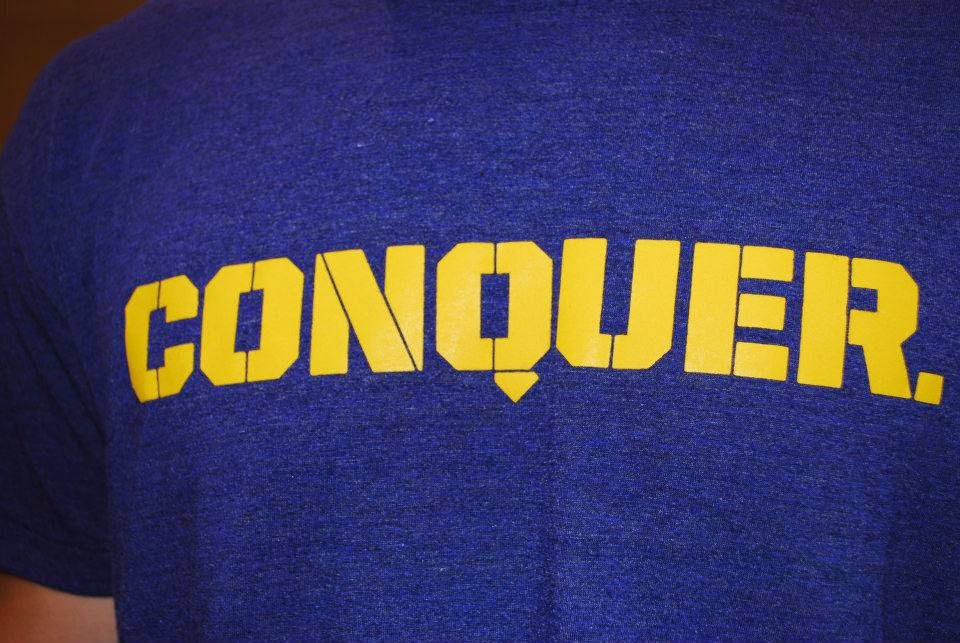
This is one of my favorite shirts from EliteFTS. Reason 1 is because it's a tri-blend and they hug your traps and lats in all the right ways. The second reason is because of the quote on the back: The will to conquer is the first condition of victory.  It's simple: in order to succeed, you have to be willing to do what you have to do.

This is when I first made the distinction between having the will to do something and having the desire to do it. When you desire to do something, it's an active emotion. You are consciously thinking "no, I'm not gonna eat that fucking pie". You're not just telling yourself "ok, I'm going to get to the gym today and that will be good", you're saying "I'm going to go to the gym and fucking crush it and make some changes".

Just having the willpower to do something isn't good enough. Find motivation (either intrinsically or extrinsically) that you need to go out and actively chase your fitness goals. You're not going to get leaner and stronger by sitting back and waiting for it to happen.

Have a good day and go lift some heavy shit!

Tuesday, July 8, 2014

How Strong Does Your Core NEED To Be?

Core training is obviously a very important aspect of a training program. Without a strong and stable core your athletes will have a tough time transferring power from their hips into any sort of ballistic movement. Instead, they will end up flaccidly flopping around and looking like a turd rather than an athlete.


I will finally concede that simply doing your basic barbell lifts is NOT adequate for core training. I will tell myself that doing heavy front squats, presses and pulls will help you develop a strong core (they will) but at the end of the day you need more than that ::sigh::.

So now that I will admit to needing more core training, what should you be doing? I've written before about my thoughts on core stability training rather than training your core dynamically. You should be training your core with standard planks, bodysaws, various anti-rotation presses and isometric holds, stir-the-pots, heavy farmers walks and long farmers walks (uni- and bi-lateral, overhead, etc). I could go on and on, but I don't want to. The point is that there are a ton of appropriate exercises to be doing, you just need to pick the right ones for you/your clients and athletes and apply them. If your athlete can't hold a standard plank without a ton of lordosis then they probably shouldn't be doing a stir-the-pot or ab wheel rollout quite yet.

This brings me to the actual point of this post: how strong does your core NEED to be? I'm asking an actual question, not setting myself up to make some grand point. Is there an upper limit to the efficacy of some of the core exercises that we can all see out there? Does training yourself to go from a bi-lateral standing rollout to a contra-lateral standing rollout significantly increase your performance in any fashion? Or is it just fucking cool? I feel like once you've increased your core strength and stability to being able to do a hand walkout on two PVC pipes, you should be pretty much good to go regarding your core strength, right? I've seen some circus tricks being passed off as core exercises and just can't find a time or a place that I'd ever actually consider putting them into a program for someone.


As I sit here and right this, I wonder if I'm not approaching it with too much of a civilian attitude. I use Mark Bell's phrase "strength is never a weakness" pretty often, and maybe I just need to remind myself that it applies to core training as well. If you're still able to make your core stronger through exercises that look ridiculous, then maybe it's still worthwhile.

I'm conflicted. Once athletes are able to perform certain core exercises without any level of difficulty I often find it difficult to continue programming any serious amount of core work. I'll still include a few exercises, but I'd much rather use that time to focus on something else that they can continue to see solid improvement with (conditioning, body comp, power, technique).

It's a question I've been pondering in my head for quite a while, and I've mostly made up my mind. However, I love learning and I'm interested to hear anybody's thoughts on the subject! Let me know what you think! Have a great day and go lift some heavy shit!

Tuesday, June 3, 2014

My Manifesto

I've written a lot on my blog about my philosophy/style of training. I make no bones about thinking that "my" style is the most effective one to improve strength, power and athleticism. If I knew a better way to achieve these goals then I would be doing that.  Heck, it can even help improve your body composition if you do it with enough gusto. Despite all this, I recently got the urge to lay it all out on the line here anyway.


I've been doing this long enough that I believe that I'm at the point where my style is more or less cemented into place. I don't foresee me suddenly making any huge changes in the way that I design training programs, but I will say with 100% certainty that I will add/subtract things as I deem necessary when their usefulness to me/my clients change.

My style is largely based upon the teachings of Cressey Performance (Tony, Eric and Greg), Dan John and Jim Wendler. If I were to apply percentages to this I'd say it's probably 40% CP, 30% Dan John and 30% Wendler (that's 100%, right?). Truthfully, the 3 sources of practice listed above are really very similar in a lot of ways. The most important (in my eyes) quality that I've learned from these sources is simplicty. So many coaches want to make the programs so unique and perfect that they fuck it all up and make it over-complicated. Training is really a pretty simple thing to do.

From Cressey Performance I've learned the importance of assessing clients so that you can then correct their imbalances. I take a slightly more remedial approach to the types of assessments that I do, because I can get away with it with my particular population. When it's truly necessary for me to learn/apply a more complicated or in-depth assessment, I will. For now, basic assessments and traditional mobility exercises applied appropriately have been working fantastically. From CP I've also learned the true power of medicine ball training (Get it? True Power?). By utilizing this tool, you can teach athletes how to produce more force in an open-chain exercise using "sport specific" (God I hate that term) movement patterns that they can translate to the field of play immediately. I try to apply medicine ball training to every session of every program that I write, even if it's something as simple as slams and vertical throws.


From Dan John I learned the concepts of truly simplistic training and the 5 basic human movement patterns. Coach John has been doing this for a very long time and has moved quite a few pounds of weight in his day, so when he talks you should be listening. At one point in his life, after many years of lifting, he saw some of his best gains ever on a simple 2x/week training program. That's it. Two days per week. While I don't think everyone should be training only twice a week, the idea stays the same: the best progress will be made when applying small consistent efforts over a long period of time. If you go H.A.M. and train 6 days per week for 4 months and then get burnt out and don't train again for 4 months, then you didn't make a lot of progress. If you lift 3 days a week, feel great and make it through a full year of training then your gains are going to be through the roof. Make sure you're training all 5 movement patterns (squat, hinge, push, pull and loaded carry) then you're going to be strong and powerful.

When I heard Coach John talk at the NSCA Ohio Clinic a few weeks ago he also talked about the idea of a "perfect program" in the sense that there isn't one. No single program can account for every variable and apply every little nugget of knowledge that the coach has. It's impossible. Instead of trying to write a perfect program, focus on writing "pretty good" programs. As long as your clients/athletes are getting stronger, faster and staying healthy then you're doing a really good job.


While Coach John introduced me to and helped me understand the concept, Wendler has really helped me apply the "small, consistent efforts" idea with his 5/3/1 program template. He urges you to "start light, progress slowly and break personal records". If you're willing to put in the hard work necessary, then over time you will see a lot of gains. Training is a process, and you have to be invested in it to get to where you want to go. Jim is also a huge proponent of "moving like an athlete", which is a concept I appreciate. Athletes run, jump and throw so you should too. Chuck some medicine balls, sprint and jump over hurdles. These are simple things that will improve your athleticism drastically. He's also one of the biggest proponents of my favorite conditioning tool; the Prowler. It's no secret that I'm not big into conditioning (for myself), but when I do it, it's generally by pushing the sled. Lastly, you'll know this if you've ever written something he wrote, Wendler is a huge "no bullshit" kind of guy: no bullshit reason about poor training, no bullshit reason to not train, no bullshit exercises that don't work, just no bullshit. I like that.


These three sources are very different but have all really taught me the same things, which I apply to my program design. Sprint, throw and jump. Lift heavy barbells and lift them fast. Use basic, compound exercises (clean, snatch, squat, deadlift, press, pull and carry) and get strong as fuck at them and good things will happen. Keep your auxiliary exercises short and to the point. The best corrective exercises are often-times movement based (if you want your squat to get un-fucked, well then squat every damn day). Keep your conditioning short and sweet. There's no need for gimmicks and tricks, and there are no shortcuts to success; just hard work and consistency. Most importantly, that strength is the foundation for everything else you want to achieve. Nobody ever said "Oh, sorry I can't, I'm too strong for that".

With that being said, there's a handful of things that I truly don't adhere to. It certainly doesn't mean that these things are bad or useless, it just means that I have not found them to be as effective with my clients and athletes and have since discarded them. There's a legitimate chance that I come back to these things somewhere down the road and find them beneficial; I'm not too proud to do this. I don't think that we, as strength coaches, need to be doing a dozen corrective exercises with athletes. Two or three specific correctives (to me, mobility and activation drills) should be sufficient and anything more than that should probably be handled by a sports medical professional (AT/PT). I don't think that many athletes need a ton of conditioning outside of their pre-season phase. Athletes (especially younger ones) are playing so many sports so often that they get plenty of conditioning there. I don't believe that we should let athletes get away with sub-optimal technique on their Olympic and power lifts just because "they are athletes, not weightlifters". That's a shitty excuse for poor coaching. Does an athlete need to have a flawless snatch? No, of course not, but they/you should still be striving for it. I like my power exercises to be power exercises and my strength exercises to be strength exercises; your intention should always be to move that bar as fast as possible. Lastly, I refuse to believe that donuts are bad for you; they just taste too fucking good post-workout.


Many people who know me personally think that I'm a cocky bastard (meh), but I'm not so brash to think that I'm the only one doing what I do, or that there aren't a lot of coaches out there doing it better than I am (*gasp* is that humility?). I know there are lots of ways of getting results that I'm not utilizing, but I apply my system well and it's been effective in my utilization. I know I'm really good at what I do, but I can look at other guys on my "level" (Dan Atkinson, Dave Rak, Miguel Aragoncillo, Greg Robins, Mike Sirani, etc) and think to myself "shit, they are fucking good, how do I get there?" I know that I'm on the right track, but there's always more things for me to learn, adapt and apply. It's all a process and I'm really looking forward to it.

Have a great day and go lift some heavy shit!

Monday, June 2, 2014

Training By My Damn Self

This past Saturday I had the chance to go train with my "team"; Mark, Nate and Alex. It's the first time since The Arnold (I think) that I've had the chance to go train with them. I usually lift alone like Stephen Fucking Glandsberg.


It pretty much sucks giraffe ass. For something as monotonous and grueling as weightlifting training can be, it's immeasurably helpful to have a training partner there to help you grind your way through your sets and give you feedback about if your technique was off or if there was just too much bitch in your heart that day. Lifting with those guys made me really miss having a training group. Heck, it was the first time in weeks I saw someone else actually snatch the barbell like a weightlifter. I was able to get some feedback from Mark on some things and was promptly put to shame when Alex (-77kg) and Nate (-85kg) both power snatched more than me.

I love weightlifting and I'm going to continue to train it, but I need a little bit of a break. I've found myself having less and less enthusiasm to train it by myself and I know that I need to change it up a little bit or I risk falling into a slump. Truthfully, I'm looking forward to spending a month or two focusing a little less on weightlifting and a little more on good ol' fashioned athletically based strength and conditioning. I think that I will physically and mentally benefit from some time spent throwing medicine balls, jumping, sprinting and doing a litany of exercises that I haven't done in a long time. I don't feel bad doing this because I don't think I'm going to really hurt my total or anything; I'm not so advanced to the point where I'm going to set myself back a ton.

I've got such a long list of useful exercises in my head that I just don't do anymore, so why not spend some time doing them again? Floor presses, chin-ups and barbell hip thrusts all sound like fun things that will ultimately still be good for me as a weightlifter. Strong is strong, especially when you're a non-competitive (I mean, sometimes I'm competitive) athlete like myself.

I would really enjoy getting my hands on some Strongman equipment for the next couple of weeks. Strongman is a really fun way to train that gets you strong (duh) and can provide a pretty serious metabolic effect. If I had my 'druthers I'd have some farmers walk handles, a yoke, a log and a really heavy sandbag or moderate stone. These implements would provide me with a ton of exercises that I could do that are just fucking fun to do. (If you've never done a yoke walk, you need to ASAP).


Truth be told, if I had the equipment available I would enjoy training Strongman just as much as I enjoy weightlifting. I would be as bad at strongman as I am at weightlifting, so it's really a one-for-one switch.

For now, I'm going to be snatching, cleaning and jerking before every training session. I still want those lifts to improve (and they have), but it will be less of a focus. I'm applying the 5/3/1 template to my strength exercises (squat, bench and deadlift) and then doing a handful of auxiliary lifts that I know I'll benefit from (GHRs, prowler marches, pull-ups, step-ups, etc).

Remember, training is supposed to be fun. As long as you're making progress in some way and you're still enjoying it, then you're doing all right. Have a great day and go lift some heavy shit!

Wednesday, May 28, 2014

Stupid Shit I Did So You Don't Have To

My career as a fitness professional has been short by most standards thus far. I've been working with general population clients and athletes alike for going on 6 years, which isn't really very much time. In this short time I've learned a lot through classes, seminars, simply discussing random shit with other coaches to see if it's dumb or not. Just like everything else in my life, I also had to learn a lot of things the hard way and eat some crow along with it. I thought it'd be interesting to run through some of the stupider things I have done or thought of along the way.


For what it's worth this will be relating exclusively to the dumb shit I've done as a lifter/coach. Even though I'm sure my Dad would be interested in reading it, there's not enough words in the dictionary for all the dumb shit I've done as a human being (lol@ the time I slept through a sociology test at UMass Amherst because I didn't go to class enough to know there was a test).

When I Thought Olympic Weightlifting Was Useless
Even though I know compete and train (mostly) as a weightlifter, there was once a time when I thought it was dumb shit. My thinking was "I can deadlift so much more than I can clean, so why would I want to do a submax lift? I'm all about Da GainZ, bro." I had zero concept of power development and technique and thought max weight was the answer to every question. Fast forward to the first time I did an overhead squat during Show and Go and had to use 75 pounds and thought "this is dumb, I can front squat way more than this". Double fast forward to when we finally decided to start learning weightlifting and (of course) thought we knew every-fucking-thing and wasted 8 months of training slamming the bar off of our hips and maxing out weekly (don't do this, get a damn coach).

When I Made A Ton of Blanket Statements
I was the fucking King of Blanket Statements back in the day. "You do CrossFit? LoL all CrossFit will kill you." "You don't squat ATG? Well, you're a bad person." "If you don't eat at least 6 eggs for breakfast you're a turd." Well, these aren't exactly verbatim quotes from me, but they all sound like something Young Mike would've said at some point. I was pretty very dogmatic in quite a few of my views, and wasn't afraid to tell anybody what my opinion was regarding a subject. I have learned now that the answer, as always, lies somewhere in the middle. No, not all CrossFit gyms are bad, a lot of them are really quite good. No, not everyone needs to squat ATG, shit not everyone needs to even squat to parallel. You don't need to eat 6 eggs, but it's awesome if you do. I don't feel bad about my previous views on things, because it's good that I believed so strongly in something...but was able to change my point of view on it.

When I Thought Bodybuilding Was Lame
Well, the sport of Bodybuilding (to me) is still lame. I just can't get down with the idea of training to get on stage and let someone else decide if your body is good enough or not. Just seems like a big ball of body issues to me.

But I used to think that bodybuilding exercises were dumb and useless. There was no need for biceps curls; that's what chin-ups were for. Lateral raises were a waste of time, just do more deadlifts. High rep DB presses weren't doing you any good, just use heavier DBs for 8 reps. I didn't see the value in increasing the cross-sectional size of a muscle if it didn't have a direct impact on strength/power. Then I learned how bodybuilding exercises could work to help prevent injuries, as well as acting like a recovery day workout to move blood all around the body and flush out all the crap you build up from training. Now I'm on that Swole Patrol.


When I Did A Diet Completely Devoid of Fat And Carbs For 11 Days
I went into this knowing it was going to be dumb as fuck, but I needed to try it anyway. Four of us undertook this adventure together and it was 50x more miserable than I thought it would be. Basically nothing but lean protein for 11 days...and fucking mustard and Mountain Dew Zero and oodles of salsa. Things I learned from this:
- I will yell at people in line at Trader Joe's
- Fat is really important for certain things. Dan and Luis know what I'm talking about.
- When you scramble egg whites they have the consistency and flavor of whale boogers.
- No amount of salsa will make whale boogers appetizing.
- Don't do this fucking diet. For serious.

When I Thought I'd Learn Everything I Needed In Exercise Science Classes


Hopefully you guys can learn from some of these mistakes. Don't forget to keep an open mind and keep learning on your own though. Have a great day and go lift some heavy shit!

Tuesday, May 20, 2014

NSCA Ohio

This past weekend my bosses and I drove the 3 hours down to Columbus, Ohio to attend the NSCA Ohio State Clinic being held at The Ohio State University.


First off, OSU was fucking amazing. Schools don't look like this back in Massachusetts. It was easily twice the size of the biggest campus we have (UMass Amherst?) and it was an absolutely gorgeous campus.

The conference was hosted by Mark Watts from EliteFTS and featured a fantastic lineup including names like Dan John, Cal Dietz, Bryan Mann and Meg Stone and was attended by about 150 people from all over the state (it's a big damn state).

Truth be told I was most excited to hear Dan John speak (I even shook his hand!); I've been reading and digesting his writing since I first become interested in getting strong and I base a large portion of my training philosophy on his teachings (the other part of my philosophy is Cressey Performance stuff). Dan presented on his 5 basic human movements and why they are important; stuff that I've read about 100 times, but it was great to actually hear him talk about it in person. He also talked about the utilization of standards and "gaps" to round out a training program for a team. Basically, if your strength standard for your team is "205 front squat, 205 clean, 275 squat" and you have one kid who squats 465, cleans 315 and front squats 330 then that is great; you have a stud athlete and he probably performs really well on the field. But, if you also have 10 kids who squat 165, clean 115 and front squat 120, then your TEAM isn't goin to be as good as it could be. If you "lift the bottom" of the team and get them stronger, rather than getting that one stud up to a 500 pound squat, then your whole unit will perform better.


Cal Dietz (University of Minnesota) was the other guy I was really looking forward to hearing speak. His system, Triphasic Training, has taken the strength and conditioning world by storm in the last two years and with good reason. Cal has an abundance of national titles and championships and various other awesome accolades under his belt. I wanted to hear Cal speak to get "sold" on the Triphasic system. I've read the book and I understand the premise of the system and why it works, but I really don't understand how I'm able to apply it to athletes that I work with. Even hearing Cal talk about it, it sounds like a pretty advanced program that is best applied to advanced/elite athletes. However, he made it seem as if it also wouldn't be as effective with a guy who'd been a pro for 10 years since his body has made so many adaptations that he'd be better off with some block periodization that was explicitly focused on one training effect.

I'm sold on Triphasic, I am. I understand that it's a fantastic system that utilizes some pretty nifty tricks to train the body to accept and adapt to more stress. But for a high school aged (or even a young college athlete) I don't think that it's a more effective way of training someone than the way I've been doing it. If your athlete is only able to squat 225, then he probably needs to get stronger so that he is able to produce more force (horsepower is useless without more torque). I hope to God that I someday get an athlete advanced enough to apply Triphasic to their program.


It was a very cool event and made me realize a few important things:

  1. I need my back to bigger in a fucking hurry. #bodyimageissues
  2. Everyone who's stronger than me (read: a lot of people) have hands that are as thick as a porterhouse steak
  3. I'm on the right track with my training philosophy.
  4. I've still got a ton of shit to learn.
Going to conferences are a great thing only if you're able to decipher what is useful to you and what isn't. Not everything that is presented is applicable or necessary for you and your athletes. If you start throwing all of these principles into your training programs willy-nilly then you're going to just end up with the proverbial "shit soup". 

Have a great day and go lift some heavy shit!

Wednesday, May 7, 2014

Training or Displaying?

When it comes to strength and athleticism there are two things you can do with your ability: you can train it or you can display it. They are separated by a thin grey line, but the path you choose will largely influence your outcome.


What you're seeing in the image above is an overhead pistol squat while balancing on a kettlebell. This is a fucking ridiculously difficult exercise that requires an absurd level of proprioception, stability, mobility and every other quality that makes an athlete amazing. This athlete is displaying an astounding level of athleticism, but I don't consider this a training exercise. Here's why.

A training exercise is an exercise that you can do consistently, in a "controlled" environment (any environment involving your body and dynamic movements is inherently turbulent) that you can consistently improve upon and progressively overload in order to reap more benefits for your desired outcome.

Training exercises are uncomfortable and tedious and arduous and only meatheads find them "fun". But they make you better for when you want to actually display your ability. If you're not careful, though, training exercises can become displays in and of themselves. If you take a simple exercise like a deadlift or a box jump and start performing it exclusively to your maximum capability, then you've started to showcase your ability rather than train it.

People fall into this trap all the time; I know I have. Putting on a display is fun! Rather than taking the time to load an exercise incrementally and get better at it, I spent several months where I would just go max out on the lift once a week (snatch and deadlift). I increased the weights on both exercises, but it wasn't that I got better at them, it's that I took enough attempts that the percentages were on my side. If I tried snatching 200 pounds enough times, I was bound to get it eventually.

Kelsi trained incrementally for her marathon and displayed her ability when the time was right. Going to the gym every day and maxing out your clean, bench and 40-yard dash isn't going to do much more than crush your CNS and leave you flaccid and weak.


While almost any exercise can be turned from a training exercise into a display, there are some (generally variations) that become displays inherently because so few people are legitimately able to do them. The DB Snatch is an exercise that I think carries a ton of value, but is better served as a display of power or a conditioning exercise rather than a legitimate training tool. The nuances of the exercise are so minimal that it's really just a "here you go, have at it" kind of exercise. I also don't think that being able to snatch a 150 pound dumbbell has any impact on your barbell snatch, but you also can't snatch a 150-pound dumbbell unless you're a strong fucker already.

Many core exercises also become so difficult that they aren't exactly trainable. Ross Enamait is a strength coach in CT and is one of the most legit savages in the industry. However, just a look at some of his core exercises let's you know that for 99% of the population this is a party trick rather than a training exercise you can do consistently over time.


There is nothing wrong with displaying your ability from time to time; that's why we train in the first place, right? But you need to make sure that you're training is appropriate to get increase your ability to display safely and sustainably.

I hope this made sense to everyone! Have a great day, and go lift some heavy shit!

Thursday, May 1, 2014

Young Athletes in the Weight Room

In my current job I work with, almost exclusively, high school-aged athletes. The kids are either currently in high school or in the prep year between high school and college. This, obviously, creates some interesting situations in the weight room.


High school kids...especially boys...are idiots. They are more interested in talking shit to their teammates and trying to make people laugh then they are in listening to directions. Getting results with a group of athletes this age is really pretty easy; they have a very low training age, and as long as your programming doesn't really really suck then you're going to see improvements.

The issue is getting these guys involved (mentally) enough into the workout to do what they need to do (especially in a group setting). Even the most dedicated athletes at this age have a tough time focusing, especially with some of their external stressors. Applying to colleges, school work, relationships, etc. Everything that happens is the end of the damned world and it affects their performance.

One of the biggest things to contend with in this environment is the bravado that comes with lifting weights. Athletes this age don't typically know anything about exercise prescription or practices, they just wan't to get yoked. They will typically regurgitate awful information that their brothers friends uncle told them, and he (obviously) benches 600. Even when applying percentage based programming to these athletes, they will have the tendency to continue to push the weights with little regard for form or tempo. The coach programmed paused bench press with a 32X0 tempo? #YOLO I'm just going to load up an extra 20kg and bounce this shit off of my sternum a bunch of times. 


You have to be pretty diligent about riding athletes this age (really, any age) about being strict with their tempo and being honest about the way the weight feels for a unique set or rep. Damn near every time I approach an athlete and tell them to decrease the weight for the next set, I get a look back like I just told them that they were adopted and that their mom was really the Tooth Fairy. No matter how often you tell them that it is not a personal attack on their masculinity or ability, they take it as such and usually demand that they get another chance at "making it look better".

The key to avoiding this situation is letting the athletes know from Day 1 that being in the weight room is not the proverbial dick measuring contest. It shouldn't matter to them what anyone else has on the bar, and nor should it matter to anyone else what they have on the bar. Their job isn't to become an amazing weightlifter or powerlifter, but to get better at their particular sport. I also don't like setting anecdotal limits like "a girl can lift this" because 1) that's demeaning to women and 2) There are some really fucking strong girls out there who out-lift a lot of people. The particular athlete you are aiming these anecdotes at is probably not choosing to be at his current strength level and since he's in the gym with you, you have actual physical proof that he is actively trying to get stronger. Telling athletes that they have to get stronger because so-and-so lifts more than them will result in sloppy movement patterns and poor tempo executions.


One of the other big things to think about when dealing with a group of teenaged athletes is their extreme propensity for bullshit. Just the other day, I was warming up a group of 18 year old basketball players. When instructed to perform inchworms I was received with a round of grumbles and a few guys who asked if they could skip it. I inquired if they really expected me to say "oh sure, just don't do it because you don't like it" and they knew that there was no chance I would let them skip it. I made the simple suggestion to them that they just stfu and do the work; if they spent as much time doing the work they should be doing as they do complaining about it, they would be good at the exercises and they would no longer suck as much.

Keeping your athletes involved and understanding why doing each exercise/drill will help them get where they want to go is amazingly important, as is helping them to realize that they occasionally just need to shut their mouths and do what the coach says for the simple fact that they are the coach.

Be firm, be clear and encourage your young athletes if you want to help them get the most of their training and prepare them for further training down the line. Really, you don't want a poorly trained athlete moving on to college and saying "hey, I learned to lift with So and So" and having their new coaches be like "well that person must suck, because this athlete lifts like doo doo".

Have a great day, and go lift some heavy shit!

Monday, April 28, 2014

Biases

So last week I was doing some of my normal weekly reading, and one of Tony's posts really hit home with me about something. 


Tony talks about how he's changed his view on things over the years that he's been training and coaching, but how he still leans towards doing things the certain way that they see fit at CP. He has grown and matured to the point where he understands why/how certain things can be applicable for certain people, but doesn't necessarily feel the need to use those things in his training on a routine basis.

This got me thinking...being biased as a strength coach is actually a really good thing. There are a hundred and one different ways to train someone in todays fitness landscape. Bodybuilding, strength, crossfit, yoga, zumba, P90x, circuit training, strongman, functional training, weightlifting, the list goes on and on.

With all of these training options nowadays, it is very easy to get confused and overwhelmed. It's not uncommon to see a trainer in a commercial gym who's business card says that they have a training certification, and certs for TRX/Boxing/Pilates/Kegels/Jazzercise/Bosu/Shake Weight. A trainer like this sort of falls under the old adage of "if you don't stand for something, you'll fall for anything".

It's correct to say that everyone can be useful and appropriate at some point for some client. Who knows, maybe someday you come across a client who is only motivated to work with a shake weight; it's your job to help them get results with that (however little those results might be). This is where being biased about something is actually a good thing.


You see, the coach or trainer that you're working with should ideally be educated about these things. I myself have been training for 6 years, while going to school and studying exercise and health science. I've gone to a number of seminars and read countless articles, papers and books on all topics relating to strength and conditioning. All of this formal and informal education has lead to me to do this thing called "thinking for myself". I train and program the way that I do because my education has taught me that it's the best. I think it's the best way to get someone happy, healthy, fit and strong. I don't think that any of the other numerous ways of getting "results" are wrong necessarily, I just don't think they are the best. I look at as many things as I can with a mind that is half open and half closed; I know that the way that I train is what I consider the best, but maybe sometimes other things can be applicable and folded into my own system. You can't ever count something out completely until you know everything there is to know about it.

If you can get results with your clients training some other way, then that is all that really matters. But, to me, a trainer who tells you that every style or program is great just doesn't know anything. That is a trainer who is struggling to make a sale and just wants you to be happy. A trainer or coach that is worth going to will have a particular style and they will make you understand why it's the best. Just a little food for thought.

Have a great day, and go lift some heavy shit!

Friday, April 25, 2014

Weightlifting Combos: Why, Who, When and How

Weightlifting combos are nothing new, they've been around for a very long time in the Olympic weightlifting world, but came to prominence recently in light of one extremely savage combo done by The Man himself.


Not for nothing, but that's 455 pounds.

First off, what's the difference between a "complex" and a "combo". As I know the terms, a complex is a series of exercises down sequentially for a given number of reps. Example: deadlift, hang power clean, push press, front squat, RDL, bent over row for 8 reps each. These are done for speed and generally for a metabolic conditioning effect; the reps are also too high to allow you to work on technique. A combo is several exercises done sequentially for a prescribed number of reps...sound familiar? The example here would be: clean pull, power clean, 2 push press, 1 jerk, with the purpose being to work on a particular weakness during a lift. I suppose its a small difference, but this is how I define the differences when I talk to someone about it.

WHY
I think the big difference is, indeed, in the purpose of the prescription. A weightlifting combo should be used to over-emphasize one aspect of the lift (snatch or clean and jerk) while under-emphasizing another aspect. It also allows you to get in more volume in that lift, with a specific weight and specific positions for a specific training effect.

Lets use the Klokov Complex from above as our example. Clean pull + clean + paused front squat + push press + paused jerk. In one of his american seminars someone asked Dmitry why he did so many deadlifts and presses and he said that it was because those are his weakness. This gives us some insight into the design of this complex. Since he wants to work on pulls, he gets in two of them (the pull and the clean). Since 205 is a "light" front squat for him (he did a 5-second paused front squat with 250kg) he adds in a slight pause to increase the difficulty. He challenges himself with a heavy push press, and since it's a relatively light jerk for him, he adds the pause during the jerk which also reinforces his jerk dip position. This combo is very specifically designed to address his weak points and reinforce some important positions.

WHO
Combo's are appropriate for any level of lifter, but the combo itself must be appropriate for that persons ability level. Taking a lifter who's been training for 5 months and throwing the Klokov complex at them is probably a poor idea. If their front squat position is poor, that will be a shitshow. Re-racking a bar from the overhead position is a skill that takes a while to learn and a paused jerk would result in a missed lift.

A more appropriate clean and jerk combo for a beginner (with a poor bar path on their clean and a lot of missed jerks) would be something along these lines: 2 clean pulls, above the knee hang clean, front squat, jerk, behind the neck jerk. This combo would give the lifter 2 pulls to the waist where they can focus on positions. Then the hang clean would allow the lifter to focus on keeping their shoulders in front of the bar without having to worry about clearing their knees. The added front squat is because, well, front squats are awesome. The front/back jerks allow the lifter to get two jerks in without having to re-rack the bar onto their clavicle, and the second jerk is the easier variation when they are already smoked.


WHEN
There are very few wrong times to use combos, in my eyes. They are very useful for building hypertrophy and work capacity at the beginning of a phase, just after a competition. They are useful for working on positions in the middle of your training cycle when you're still ironing out the kinks, so to speak. I would not, I think, use them pre-competition. That's when you should be focusing on getting comfortable handling the weights you need for your competition. They would be, however, useful during a deload week since combo's are, by nature, a lower intensity exercise.

HOW
I use combos' pretty regularly in my training/programming. Let me outline a couple of my favorite combos and why I apply them.

1 Snatch Pull + 1 Hang Snatch below the knee + 1 hang snatch above the knee
- I use this combo because one of my big issues is clearing my knees in the snatch. The pull to my knees is pretty good, but once I get to my knees shitty stuff starts to happen. This let's me work on various aspects of the first and second pulls in sequence, and I can feel where I'm messing up.

2 Hang Power Snatch + 1 Hang Snatch
- I do these above the knee; I'm really bad at hang snatches. I get my hips way back and shoulders over the bar instead of out in front; this makes me bang the bar off my hips and gives me a shitty bar path. I am able to use a lighter weight and focus on my positions and really pulling the shit out of the bar. The last full snatch lets me use that long pull I just developed and really dive under the bar without any "weightlifters disease".

2 Power Clean + 1 Jerk
- I clean more than I jerk, so I tailor my combos to reflect that usually; this is the exception. I power clean less than I full clean, so this combo allows me to work on staying over the bar and pulling hard on a lighter weight. The jerk still takes "thought" for me to do, and I can focus on getting a really solid dip out of it, rather than bench pressing it.

Clean + Push Press + Jerk
- I actually really like this combo for myself. Performing a push press before the jerk forces me to drive with my legs and (hopefully) keep my heels down. I go to my toes too early during my jerk (just like everything else) so doing my push press without lifting my heels reinforces that motor pattern.


1 Clean + 1 Jerk + 1 BTN Jerk
- I apply this combo to myself to get the feeling of higher percentages. My jerk is a shithole, so doing a jerk double with a high percentage is doomed to failure or shitty technique (same thing, right?). I skirt this issue by doing my first jerk and then dropping the bar onto my back, where I can do a BTN (behind the neck) jerk. This second jerk feels "easier"and let's me get in a second rep with that heavy weight.

As I said before, there's nothing magic about simply performing combos. You need to do the right ones at the right times in order for them to be successful. Practice doesn't make perfect; perfect practice makes perfect. Start making up some of your own, focusing on your weak points and see what happens...and don't forget to track your progress!

Let me know what you're trying and how it works for you. Have a great day and go lift some heavy shit!
Thursday, April 24, 2014

Twenty Six Point Two

This past Monday I got to witness one of the more special events I've been able to see. I got to see my girlfriend Kelsi run the 118th Boston Marathon.


This was special for a few reasons; the most unfortunate of which is what happened last year when a couple of assholes turned the city of Boston into an episode of CSI for a week. We all know what happened, so I won't delve into that anymore than I needed to.

The coolest reason that this was a special event was because of how fucking hard Kelsi worked for this. I always knew that she was a hard worker, but that took on a whole new meaning when she started her marathon training about 4 months ago. She was running a ton of miles in the middle of winter in a place that isn't exactly friendly to running 20 miles outside (it snowed on Sunday during her long run for like 6 weeks straight). She will be modest and tell you that her training isn't anything different than that of all distance runners, but I'm not there to watch all the other distance runners bust their ass for a race.

Training for all sports is tough; I've considered training for weightlifting to be some of the most arduous training that I've ever done. It's repetitive and painful and frustrating and just brutal at some points; but it doesn't hold a candle to what I saw Kels go through. Aches and pains and zero programmed days off while running 70-75 miles a week. I used to think that doing 6 or 7 sets of 3 clean and jerk was brutal; it's nothing compared to having to run 13 miles between classes and then find some time to study.


All of her hard work paid off, though. She ran a 16 minute PR and broke the 3-hour mark which was her ultimate goal. She ran 2:59.06 and said it was the hardest race she's ever run. The hills in Newton were worse than she'd thought and she wasn't sure if she'd make it at some points. But she loved it and was thrilled with how she did. The whole event was amazing for her, and she had a great time doing it. The signs, the crowds, the whole spectacle of the event was worth it.


I know that she now feels a little bit weird; she'd trained so hard for this race that she's got that "lost" sense that athletes tend to feel when their event/season is over. I know that once her training starts up again in a week that she'll fall right back into stride (pun not intended, but totally intended) and get ready to smoke her next race. To her coach and teammates, I personally want to thank you for helping her so much during this race prep; I know she couldn't have done it without you all.

Kels, I'm proud of you babe. You did an amazing job.

While running a marathon is pretty much the last thing I personally ever want to do, we can all certainly learn a lesson (or 8) about how to work hard to achieve a goal. Anything that you're doing that is "so hard" could always be worse. Work as hard as you can, and the results will be worth it.

Damn, I look Swole.
Have a great day, and go lift some heavy shit!

Tuesday, April 15, 2014

4 Tips For Completing A Training Program

So you've taken the plunge and decided to actually participate in a strength and conditioning program. Maybe you contacted a professional like me or Tony to start getting awesome with a personal touch (don't make it creepy). You could've searched around and purchased Show and Go, High Performance Handbook, 5/3/1, The Juggernaut Method or The Cube Method. You could've even gone to T-Nation or *shudder* Bodybuilding.com and found one of their pre-fab programs. (What I'm trying to say is that you have a lot of options, there's no excuse for following a non-program program.)


Now that you've got your shiny new program in hand, you'd think that it would be a simple matter of following directions, but people often like to make simple stuff hard. I've written a lot of programs for people that I wasn't physically training and as such have come up with a few tips to help you make your experience easy and successful. Listen up!

1) Follow the fucking directions. This may seem like a no-brainer, but it's not unfortunately. I used to program for a guy that came to my gym, and one day I walked into the weight room and say him pulling 335 pounds for a single...and his previous max was 315. I asked what exactly in the blue fuck he was doing since I'd not programmed in any max attempts. He told me that he "felt good deadlifting the other day and was pissed about missing this weight the first time (when he maxed pre-program) so he wanted to try it today after benching". Yup, he'd already pulled once that week and decided to max out post upper body workout because YOLO.

Don't ad-lib on your program unless you absolutely have to. Don't change front squats to back squats because you don't like front squats. If your program uses percentages, don't add extra pounds because you feel like it. If it's a 3 times per week program, do your lifts 3 times per week. Whatever you're thinking about changing, just don't. It was written that way for a reason. If you have a legitimate issue, then talk to your coach/trainer about it before you go changing it.

2) Ask questions! If your coach isn't a bum, then he/she will be more than willing and able to answer questions about the program they wrote for you. If you got a pre-fab program (5/3/1 or Show and Go) then ask a trusted fitness professional for their opinion. I've had people go through a full month of programing doing the wrong variation of an exercise because they thought it was something it wasn't. Don't be that person. The only stupid question is the one you don't ask.

3) Track your progress. There are many ways for you, the athlete, to track your progress when performing a program. One of the simplest and most effective ways is progress pics: take a picture of yourself in a bathing suit at the start of the program and continue to do so every 4-6 weeks and again at the end of the program. It will allow you and your coach to both see the progress in a very clear cut way.

The next best way to track your progress is by keeping a workout journal. Track how you're feeling, the weights your using (if they aren't prescribed), what you're eating and how you're sleeping. Give your coach this feedback and they can use it to develop your next month of programming.

4) Work hard. Pretty simple, really. When provided with the proper instructions you should be able to just put your head down and go. Do the work that's put in front of you and give it everything you have. Training is pretty simple, you get back exactly what you put into it.


That's it for today; follow these tips next time you start a training program and I guarantee it will be a  much better experience for you. If you have any questions or want to start your own personalized program shoot me an email at michaelkaneanderson@gmail.com and I'll get you going.

Have a great day, and go lift some heavy shit!

Tuesday, March 18, 2014

Thoughts On Tempo Prescription

In the last year or so it has become increasingly popular to prescribe tempo to any number of lifts; Charles Poliquin has used them for years and Cal Dietz made them popular again with Triphasic. If you've ever performed one of my programs over the last few years then you know that I personally use a lot of tempo stuff during the A-tier (primary lifts) portion of the lift.

how you feel after tempo front squats
First off, what is tempo? Tempo simply refers to the pace of the lift. Tempo prescriptions (should) have 4 parts: the eccentric/lowering phase, the amortization/isometric phase (ooooh big word), the concentric/lifting phase and the period of rest at the top of the lift. When written out, it could look like this "5873". This would ultimately be the worst tempo in the world: a 5 second eccentric, 8 second pause at the bottom, 7 second concentric movement and a 3 second pause at the top. That would suck donkey balls, truthfully.

If tempo sucks, why do we use it?
Great question! Tempo-ing a lift can do a lot of things for a lot of different people. For beginners, it can allow them to feel their way through the particular positions that you want them to learn on a lift; sitting their hips back, keeping their elbows tight, keeping their core braced, etc. Since they are going to be moving in a controlled fashion, it will limit the amount of weight they can use which will, again, allow them to focus more on their technique than on mashing their way through reps.

For an intermediate lifter, it will increase the time under tension (TUT) of a lift, which will help make you stronger and bigger. There have been a bunch of studies done on eccentric training that show significant increases in strength and force production. This is because your muscles have to produce more force to slowly control a weight on the way down, rather than simply produce some force and using your lever system to lift the weight up. This can help intermediate lifters break through some plateaus in various lifts.

Advanced lifters can use tempo for all the same reasons, and also for a change of pace. You can't just always hit it hard and aim for X reps at Y percentage, you'd run yourself out. Switching it up and using some tempo for a phase or two here or there will keep bodies healthy and keep training fresh.

This has nothing to do with anything.
Con's of Tempo
Despite how much I like using tempo for various populations and at various times in a programming phase, there are some legit negatives to it. The first is that it does indeed force you to use a lower weight, which is good sometimes and bad sometimes. You will, occasionally, want to work at a normal pace to see what sort of weights you can push. If you increase that weight, then the weights you can do a tempo with will also increase (obviously). Another con is that if someone can't control their bodies during a tempo'd lift, they are just going to end up ingraining a poor movement pattern. If you bench with your elbows flared way out normally and don't understand HOW to keep them in, then this isn't going to help clean up your form. It's not a replacement for good coaching.

Probably the biggest con of applying tempo to lifts (dependent on which phase the athlete/client is in) is the overall stress it provides to the body. Heavy eccentric work will often leave the trainee with significant soreness in the affected body parts; I did some tempo front squats yesterday and my legs and upper back are feeling it today. Ask anybody who does 5-second negative pushups for the first time with me how their upper body felt for the next couple of days! The soreness you experience diminishes when you do them more, but if you're doing them right you'll still feel the systemic "tiredness" that you get when you're really taxing your CNS. Make sure your athletes/clients are aware of this so they understand how they are going to feel and make sure you're programming it at the appropriate time of year (i.e. not an in-season prescription).

How to Apply Tempo to Your Lifts
In the most literal sense, you can apply a tempo to any lift that you want to; but you really should be considering the muscle groups and actions before just throwing a tempo at anything you happen to be doing. If you start doing that you're just going to have a lot of sore muscles and a big pot of Shit Soup.

Traditionally, tempo is best with big compound exercises. Some of my favorites include: squats, pushups, pullups/chinups, bench press, bodysaw, RDLs and Trap Bar Deadlifts. These are lifts where you can go (relatively) heavy with good form and reap all the benefits of the increased TUT. Pullups are tough, you've gotta be pretty damn good at vertical pulling to be able do them; I'd more likely start someone on a cable pulldown first.

Some exercises that I really don't like doing a lot of tempo on are conventional deadlifts (too big a ROM), vertical pressing (DBs or Barbell), and most rowing variations. The reason for most of these is that it puts your body in such a tough position to create and resist force. You end up compensating a lot and using poor positions that will (again) create bad habits or, worse, put you at risk for injury. There's no serious benefit to adding a tempo to a bent over barbell row.

I suppose you can derive benefits by adding a tempo to curls, triceps exercises and other bodybuilder style exercises, but it's not something that I personally would do. If that floats your boat then go for it.

Regarding the tempo prescription itself; there's no hard and fast rule. I personally prefer 3-5 second eccentrics with various pauses at the bottom depending on the desired training effect. This is enough of an eccentric component to create a change, but not so much that it will drastically reduce the training load or put form at risk. For some more advanced clients, 8-10 second eccentrics can produce some pretty serious strength advantages, but I think that beginners won't really benefit because the load used will be so minimal. All in all, my most used tempo is 31X0 and 53X0.

don't tempo this
Remember that there is nothing intrinsically wrong with tempo, but there needs to be a time and a place for it. Take everything into consideration and as long as you can give a good reason about why you're doing it, then you're ok.

If you have any questions or comments, hit me up below. Have a great day and go lift some heavy shit.

Monday, March 10, 2014

Snatches and Athletes

I love the snatch. It's one of the two lifts I compete in, and when performed correctly it's a beautiful combination of speed and power. But, when it's performed poorly it's an awkward clusterfuck of limbs and joints and barbells.


People (myself included) often debate about doing the snatch with general population clients; I personally never snatched with a client when I was a personal trainer, but that doesn't mean it is inappropriate. It just means that I never saw had a person with whom I said "they need to start snatching". Whether it was a coordination issue, a mobility/flexibility contraindication, or simply that it wouldn't benefit their goals I never saw a reason to teach it.

With athletes, however, I've done quite a bit of snatching. At Boston University a majority of the teams snatched, exclusively the hang-power variation. Many of the teams did the clean-grip or close-grip variation that has been popular in collegiate settings for quite a while. At my current job, too, nearly all of the athletes snatch. But do they really need to?

First off, I'm not a big fan of the clean-grip snatch. Most people, myself included, don't have the mobility to be able to keep a bar close enough to our bodies to have a good bar path, nevermind catching the bar overhead in the power position with a shoulder width grip. This variation promotes a poor bar path and catch position, and to be successful with it the athletes have to use a very low load. There are very few people who do this exercise well, more often than not they are elite level weightlifters. Call me crazy, but I'm not a huge fan of exercises that inherently promote poor form and require an obnoxiously low load.


Now, should athletes be doing conventional hang power snatches? Truthfully, I'm uncertain. It's a fantastic exercise where the barbell has to be moved at a high speed requiring a ton of power. However, this is all sacrificed for the sake of technique. If an athlete has poor snatch technique they will leak power all over the place and their weights be consistently be limited. They could start trying to compensate for poor bar paths with awkward catches and put themselves at risk for injury.

Not that the clean is an easy exercise, but it's certainly much less complicated than the snatch. The mobility requirements are also significantly less which means more athletes can do it and with less time spent on correcting all the contraindications preventing them from doing it in the first place. This means that you can get athletes training earlier, with less time spent on technique, with a training load that will induce more changes.

And yes, I'm aware that you can move a lighter weight faster but I'd still rather have a freshman in college who can hang clean 225 pounds rather than one who can awkwardly hang snatch 95.

I'm in no way suggesting that the snatch is a bad exercise or that athletes don't need to perform it; there are oodles of team sport athletes out there snatching big weights with fantastic technique. But it's not a one-sized-fits-all exercise (none of them really are). When you're deciding whether or not to include this in your athletes programming, please consider if you are a good enough coach to make it effective and if your athletes are good enough to be able to benefit from it.

Thanks for reading. Have a great day and go lift some heavy shit!

Wednesday, March 5, 2014

New Programming

Now that the Arnold is over, I've started prepping for the next meet. Mark said there might be one in early April and I really want to be ready for it. I'm tired of "being happy about competing", I'm ready to get some motherfucking PR's in this bitch.


I did something that I always say not to do and I wrote my own program. I learned quite a bit during my time doing Risto Sports programs, and I've learned just as much during my time so far in Ohio training with Mark. Mark has been brutally delicately dissecting my technique flaws over the last few weeks and I'm using certain exercises to address those issues in this next month of training.

I'm also addressing my strength issue. My squat max hasn't gone anywhere in a long time, and that bugs me. Will it make me a better lifter? Not directly, but when your squat goes up it always has an indirect effect on your lifting.

Snatches: 
My snatch technique was super-fucked, to put it bluntly. Now, after some work, I think it's just regular fucked. My bad habits have been whittled down and are now (as far as I know): my second pull, my extension, bar path and"frozen feet". During the second pull, I was bringing my hips forward to the bar rather than bringing the bar into my hips. This is short changing my power and creating a shitty bar path that makes me miss forwards. It also causes the second problem, which is my extension. I'm early onto my toes every time which causes an even shittier bar path. I didn't realize it was an issue, but I suffer from "frozen feet", which is when my feet never leave the pull position. You often hear "pull position/squat position" but those were the same for me, which I thought was ok because I squat with a really narrow stance. Mark has been working on correcting this and I'm finally starting to get the hang of it. 


You can see in that picture that when the bar is in my hip crease, I'm already extending through my ankles (i'm also throwing my head back). At that point my feet should still be flat on the ground while I push through my ankles. 

To address and correct these issues I'm going to be performing a lot of hip snatches, power snatches, "no hook no feet" snatches (a full snatch without using a hook grip or moving your feet at all, Mark wants me staying completely flat on my feet the whole time) and some 3-pause snatches to work on my positions (just off of floor, at knees, final position). These are all pretty lightweight training lifts (I've been performing them so far at just less than 80%) but working on my technique will have the biggest benefit for me right now. 

Clean and Jerk:
My clean technique isn't nearly as bad as my snatch, but I'm still early into my toes and bringing my hips to the bar and not bar to hips. I think one of the culprits of this is the way that I performed RDLs for such a long time. I have a "frozen foot" when I clean because my right foot will shoot out but my left stays planted. My jerk is my weak point (I out-clean my jerk by probably 15kg), and it all starts with my dip. I have a tendency to let my chest fall forward and my hips drift back, which causes me to push the bar out in front of my body. This happens at heavier weights, so my plan is to spend more time working with weights closer to my max than I would have previously. I also want to spend more time performing the jerk in a more fatigued state, like you would be after hitting a max clean.

To address these issues I'm actually going to be doing a few combo exercises and a lot more jerks. The reason I'm doing some combos is because of the difference in my clean and my jerk. I can use a lighter weight and still get a training effect for my clean while working at a high percentage of my jerk. The exercises I'll be training are: power clean+2 jerks, clean pull/power clean/full clean and jerk (did this yesterday and loved it), BTN jerks, and clean pull/hang power clean. I'll be able to work on some positional stuff and get in some good jerk volume at a good percentage. We'll see how it works!


Squats:
I'm just going to do a fuckshitton of squats this month. Whether it directly helps my lifting or not, I really want to squat 200kg this year. No real plan this month for that, just a lot of triples and a volume day of sets of 5. And probably some ammonia.

That's what I'm up to. Any new plans from you guys?

Have a great day and go lift some heavy shit!